How we end chronic encampments, deliver wrap-around mental health and addiction treatment, and restore public spaces without burdening local property taxpayers.
Guelph is facing a critical juncture. Across our city from our downtown core to neighborhood parks we see the visible impacts of chronic homelessness, unmanaged addiction, and untreated mental health crises. The status quo is failing everyone. It fails the vulnerable individuals sleeping rough in winter conditions, and it fails local business owners, families, and emergency services stretched past their limits.
For too long, local discussions have been trapped in a false choice between basic human empathy and public safety. Temporary band aids, emergency shelters, and piecemeal court battles do not solve the root problem. They merely rotate individuals through emergency rooms, police interactions, and temporary encampments at immense taxpayer expense.
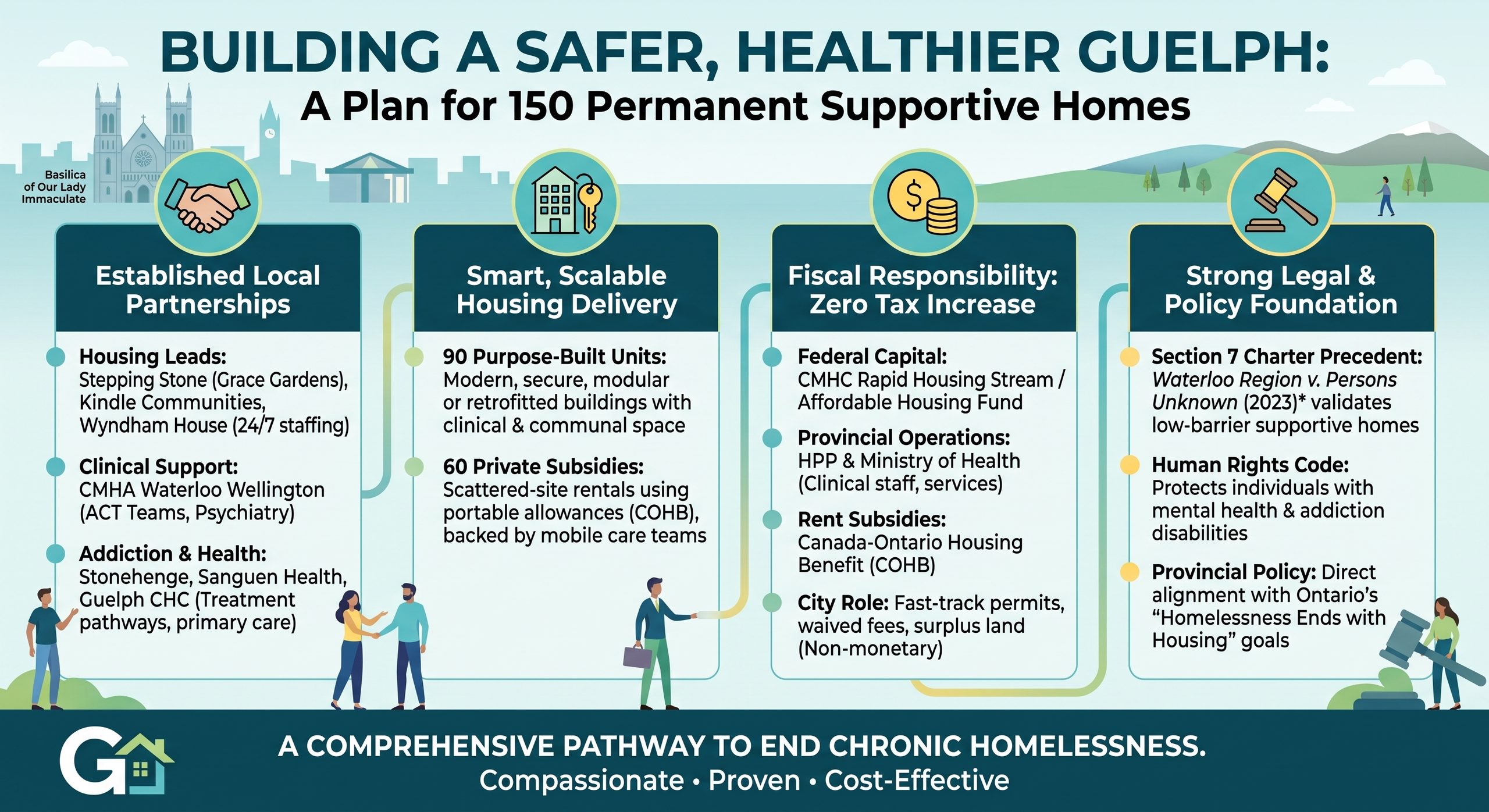
We need a permanent, realistic, and legally sound solution. This campaign is putting forward a fully costed, action-oriented policy framework: establishing 150 Permanent Supportive Housing (PSH) units across Guelph anchored in a Housing First model with 24/7 clinical wrap-around care.
The 4-Pillar Comprehensive Framework
1. Unified Local Partner Delivery Network
We do not need to create costly new municipal bureaucracies. Instead, our plan scales and coordinates the proven non-profit and healthcare expertise already operating in Guelph:
- Housing Management & Operations: Scaling success models like Stepping Stone’s Grace Gardens (32 units) and Kindle Communities’ 10 Shelldale project (32 units) to manage secure, 24/7 staffed developments. Wyndham House will manage dedicated youth units (ages 16–24) to interrupt intergenerational homelessness.
- Mental Health Stabilization: Direct integration with CMHA Waterloo Wellington (CMHAWW) to deploy specialized Assertive Community Treatment (ACT) teams, psychiatric care, and intensive case managers inside supportive sites.
- Addiction Care & Primary Health: Partnering with Stonehenge Therapeutic Community, Sanguen Health Centre, and the Guelph Community Health Centre (Guelph CHC) to deliver low-barrier harm reduction, mobile nursing, primary medical care, and clear voluntary pathways into residential addiction treatment.
2. Hybrid Housing Model (Speed & Community Fit)
To achieve 150 units quickly without overburdening single neighborhoods, we deploy a balanced 60/40 hybrid housing strategy:
- 90 Purpose-Built / Modular Supportive Units: Three 30-unit, modern, modular developments or commercial retrofits featuring single-occupancy rooms, secure key-card access, communal kitchens, and dedicated on-site clinical offices for healthcare staff.
- 60 Private Market Scattered-Site Subsidies: Head-lease partnerships with local private landlords utilizing portable housing allowances, paired with roving Intensive Case Management (ICM) teams to maintain property standards and community safety.
3. Fiscal Responsibility: Zero Property Tax Rate Increase
Opponents of social policy frequently raise concerns over tax hikes. Our plan funds both capital construction and ongoing healthcare operations by unlocking senior government grants, health ministry budgets, and philanthropic partnerships.
| Funding Stream | Target Source | Specific Application |
| Federal Capital Grants | CMHC Rapid Housing Stream / Affordable Housing Fund | Covers up to 70–80% of upfront construction or modular acquisition. |
| Provincial Healthcare & Operational Funding | Homelessness Prevention Program (HPP) & Ministry of Health | Underwrites 24/7 clinical staff, ACT teams, addiction services, and site security. |
| Rent Allowances | Canada-Ontario Housing Benefit (COHB) | Provides direct, portable rent subsidies to bridge the gap to market rental costs. |
| Community Equity & Philanthropy | Home for Good Campaign (United Way Guelph Wellington) | Fills capital gaps and specialized equipment needs through private donations. |
Municipal Role: City Hall will not fund capital operations through residential tax increases. The City’s contribution is strictly functional: expediting planning approvals, waiving municipal development fees, and transferring surplus municipal land where appropriate.
4. Legal Precedent & Sound Policy Foundations
This initiative complies strictly with current Canadian constitutional law and Ontario housing frameworks, ensuring policy longevity and resistance to legal challenges:
- Section 7 Charter Compliance (Waterloo Region v. Persons Unknown, 2023): Landmark rulings in Ontario Superior Court established that municipalities cannot enforce bans on public encampments unless accessible, low-barrier shelter and supportive housing alternatives exist. By building 150 supportive units, Guelph secures the legal foundation required to enforce public space bylaws while protecting fundamental rights.
- Ontario Human Rights Code Protection: The OHRC protects individuals with severe mental health conditions and substance dependencies under disability standards. Providing structured support aligns with our human rights obligations.
- Alignment with Provincial Strategy: Directly reinforces Ontario’s Homelessness Ends with Housing priorities, placing Guelph at the front of the line for provincial health and operational funding.
The Real Cost: Reactive Emergency Response vs. Permanent Supportive Housing
When critics argue that supportive housing is costly, they overlook the massive hidden costs of our current crisis. Managing homelessness through emergency services is exponentially more expensive to taxpayers than providing supportive housing:
| Service / System Response | Estimated Cost Structure | Community Outcome |
| Hospital Inpatient Stay | ~$700 to $1,500 / day | Temporary crisis care; discharge back to homelessness. |
| Provincial Incarceration | ~$250 to $350 / day | Extremely high cost; fails to address addiction/mental health roots. |
| Emergency Shelter Bed | ~$100 to $150 / night | Temporary shelter; no long-term clinical stabilization. |
| Permanent Supportive Housing | ~$50 to $75 / day | Long-term stability, 24/7 care, treatment, and public safety gains. |
Managing a city requires leadership that balances compassion with rigorous operational and financial planning. We cannot ignore the human suffering on our streets, nor can we expect property taxpayers to shoulder federal and provincial healthcare gaps.
By coordinating our outstanding local non-profits, securing senior government grants, and building true supportive housing, we can end chronic encampments in Guelph and build a safer, healthier city for every neighbor.
Together, let’s build a stronger Guelph.
Expanding the Blueprint: Proven Models, Statutory Tools, and Accountability
When addressing complex social challenges, good intentions are not enough, we need proven frameworks backed by law, strict accountability, and real-world evidence from across Ontario.
1. Breaking Organizational Silos: The “Built for Zero” Coordinated Model
A common critique of social initiatives is that health, housing, harm reduction, and emergency service providers often operate in silos. Our framework overcomes this by establishing a Coordinated Access System (CAS), modeled after successful system responses in London, Ontario and Waterloo Region:
- Shared By-Name List: Every individual accessing one of the 150 supportive units will be drawn directly from Guelph and Wellington County’s real-time, shared data system. This ensures housing is prioritized strictly for local residents currently sleeping rough or in local shelters.
- Integrated Care Pipelines: Rather than requiring individuals to navigate disconnected agencies, healthcare teams (psychiatry, primary nursing, and addiction specialists) operate directly within housing facilities. Clinical care follows the resident.
2. Statutory Tools to Fast-Track Development
City Hall has powerful municipal planning tools under Ontario law to accelerate supportive housing construction without drawing on residential tax revenues:
- Planning Act Delegations (Section 28 & Community Improvement Plans): The City can utilize expedited zoning pathways and pre-approved modular housing sites to bypass years of bureaucratic delays and high developer overhead.
- Community Safety and Well-Being Mandate (Police Services Act, Part XI): Ontario law requires municipalities to implement integrated plans that reduce demand on emergency services. Frontline police and paramedics consistently report that emergency rooms and cellblocks are not equipped to manage chronic healthcare crises. Permanent supportive housing directly fulfills our statutory mandate while preserving police capacity for community safety.
3. Repatriating Our Federal & Provincial Tax Dollars
This plan leverages existing statutory funding frameworks designed to support municipal housing initiatives:
- National Housing Strategy Act (2019): By aligning Guelph’s supportive housing strategy with federal housing targets, our applications gain priority scoring for the CMHC Affordable Housing Fund. This ensures federal tax dollars already paid by Guelph residents are brought back to fund local infrastructure.
- Provincial Health Priorities: Ontario’s Homelessness Ends with Housing policy explicitly directs operating funds toward multidisciplinary mental health and addiction teams. Securing these provincial health dollars ensures 24/7 care costs are covered by provincial health budgets rather than municipal property taxes.
Why Supportive Housing Is the Safer, Smarter Path Forward
- Does this attract people from outside Guelph? No. Access to all 150 units is strictly tied to our local, verified By-Name List, ensuring resources directly serve individuals currently unhoused within our community.
- Can people stabilize without secure housing? Decades of research across Canadian municipalities show that housing stability is a necessary foundation for recovery. Expecting an individual to overcome severe trauma or addiction while surviving in an unheated tent is unrealistic. Providing a secure home with 24/7 on-site clinical care creates the stable environment required for voluntary treatment and long-term recovery to succeed.