As someone who has organized with local tenants to fight Above Guideline Increases (AGIs), I know firsthand the immense financial pressure renters are facing. We cannot just wait for the private market to solve a housing crisis it helped create. The City of Guelph has the tools, the land, and the legal authority to transition from simply regulating housing to actively building it.
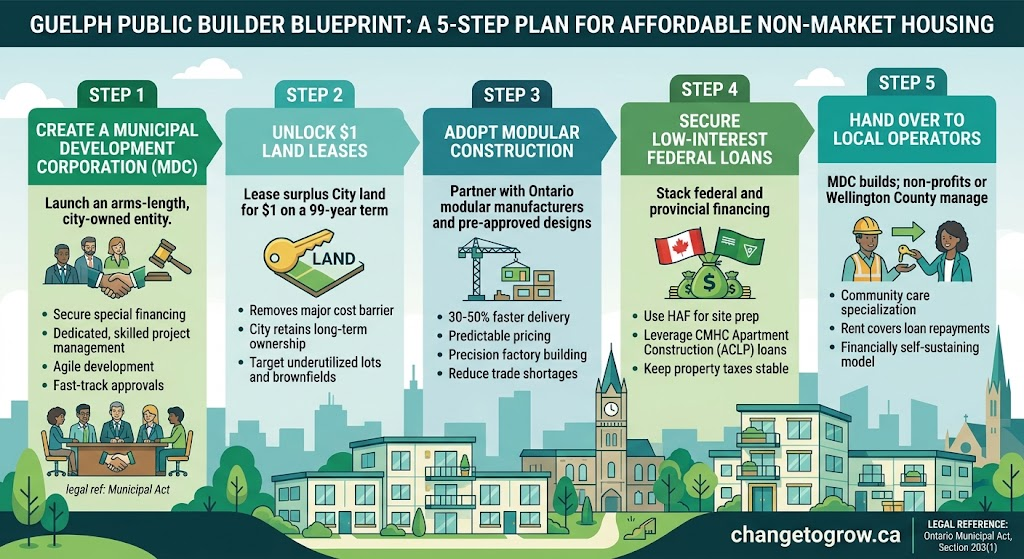
To deliver homes that are actually affordable, we need to adopt a Public Developer framework. Here is my 5-step blueprint to get shovels in the ground:
1. Establish a Municipal Development Corporation (MDC)
City bureaucracies are designed for regulation and zoning, not agile real estate development. We will create an arms-length Municipal Development Corporation. Wholly owned by the City, an MDC operates with private-sector speed—hiring project managers and managing supply chains without bottlenecking City Hall’s planning staff.
2. Execute a $1 Land-Lease Strategy
Land acquisition is the biggest financial barrier to building affordable homes. Instead of selling surplus City land (like underutilized parking lots or old depots) for a one-time cash injection, the City will retain ownership of the public asset and lease it to the MDC for $1 on a 99-year term. The development project gets free land, instantly stripping a massive percentage off the total construction cost.
3. Standardize with Modular Construction
With a severe shortage of skilled trades, traditional site-built housing is too slow and financially unpredictable. We will partner with Ontario-based modular manufacturers. Factory-built housing can be delivered up to 50% faster, locking in per-unit pricing before a shovel hits the dirt. By using pre-approved blueprints from the CMHC Housing Design Catalogue, the MDC can drop multiplexes onto municipal lots with near-zero architectural delay.
4. Stack Federal & Provincial Financing
To build without spiking local property taxes, the MDC will operate using leveraged capital. The City can use portions of its federal Housing Accelerator Fund (HAF) to cover site preparation and water/sewer upgrades. For the physical construction, the MDC will secure low-interest, long-term financing through the CMHC’s Apartment Construction Loan Program (ACLP) and Infrastructure Ontario loans, which explicitly reward modular builds and affordable projects.
5. Separate Building from Operating
Building a home and being a landlord require entirely different skill sets. Once the MDC completes a building, it will hand over operations to an established local housing non-profit or the County of Wellington (our regional service manager). They will manage the building, collect the affordable rent, and use that revenue to pay down the construction loan—making the building financially self-sustaining without ongoing municipal bailouts.
The Proof: It Is Legal, and It Is Working in Ontario
For those wondering if a municipality can actually do this, the answer is a definitive yes:
- The Legal Authority: Section 203(1) of the Municipal Act, 2001 gives municipalities in Ontario the explicit statutory power to establish corporations, allowing cities to secure specialized financing for infrastructure and housing development.
- The Toronto Model: Toronto established CreateTO, a municipal real estate agency that unlocks city-owned land for the public good. Through initiatives like Housing Now, they are currently delivering thousands of affordable rental homes by offering 99-year leases to developers and non-profit operators.
- Regional Successes: Across the province, wholly owned municipal entities like the Toronto Community Housing Corporation (TCHC) and CityHousing Hamilton prove that public housing providers have the capacity to successfully operate, build, and deliver at scale.
Legal and Statutory Framework for the Public Builder Blueprint
| Blueprint Step / Concept | Governing Statute or Policy | How It Enables the Plan |
| 1. Establishing an MDC | Municipal Act, 2001 (Section 203) & O. Reg. 599/06 | Grants municipalities the explicit statutory power to establish a Municipal Services Corporation (MDC). This allows the city to create a wholly owned, arms-length entity with the agility to manage real estate development outside of standard city bureaucracy. |
| 2. $1 Land Leases (Below Market Value) | Municipal Act, 2001 (Section 110) & Planning Act (Section 28) | Section 110 allows municipalities to enter into agreements for “municipal capital facilities,” which explicitly includes affordable housing, permitting the lease of city land at below-market rates. Section 28 (Community Improvement Plans) further allows cities to lease or sell land to execute community development goals. |
| 3. Modular Construction Standards | Building Code Act, 1992 & Ontario Building Code (CSA A277) | Modular buildings constructed in factories certified under standard CSA A277 are recognized by the Ontario Building Code. This allows the structural, plumbing, and electrical components to be pre-approved at the factory level, bypassing lengthy local municipal site inspections for those components. |
| 4. Low-Interest Financing | National Housing Act & Ontario Infrastructure and Lands Corporation Act, 2011 | Federally, the CMHC’s Apartment Construction Loan Program (ACLP) is authorized to provide low-cost, long-term financing to municipal entities building affordable apartments. Provincially, Infrastructure Ontario is mandated to provide affordable, long-term financing directly to municipalities and their MDCs for capital projects like housing. |
| 5. Operating Partnerships | Housing Services Act, 2011 | Establishes the framework for regional Service Managers (like the County of Wellington) and non-profit housing providers to operate and manage social and affordable housing on behalf of, or in partnership with, municipalities. |
Where has this already been done
City of Toronto: CreateTO and the Modular Housing Initiative
- Toronto established CreateTO as an agency to manage its real estate portfolio and deliver affordable homes on city-owned land.
- The city retains ownership of the public land by offering 40 to 99-year leases to developers and operators.
- Through the Modular Housing Initiative, the city has completed 216 prefabricated, factory-built modular homes to provide deeply affordable supportive housing.
- Specific completed modular projects include builds at 11 Macey Ave., 321 Dovercourt Rd., 540 Cedarvale Ave., and 39 Dundalk Dr..
Ottawa Community Housing (OCH)
- Ottawa’s municipal housing corporation acts as a direct builder for new affordable and community housing.
- Current new construction communities managed by OCH include 300 Mìwàte Private, 715 Mikinak Road, and 2950 Penny Drive.
Region of Waterloo: Land for Housing Strategy
- Through its “Homes for All” strategy, the Region of Waterloo explicitly targets vacant, surplus municipally owned land to be converted into housing.
- The Region is collaborating with community partners to execute affordable development on public land, such as the mixed-income housing project at 1388 Highland Road West in Kitchener.
CityHousing Hamilton
Hamilton’s municipal provider functions as a public developer, growing its affordable housing stock through active new construction projects and commercial property conversions.