When we think about what makes Guelph a remarkable place to live, our vibrant arts, culture, and heritage sectors are right at the top of the list. From historic walking tours along the Speed River to local theatre, festivals, visual arts, and music, our creative sector isn’t just a community amenity it is a powerful economic engine, a driver of downtown foot traffic, and a core pillar of our civic identity.
Yet, for too long, municipal funding and planning have treated arts and culture as secondary or discretionary line items rather than strategic civic investments.
To build a thriving, forward-looking city, we need smart, accountable municipal leadership that replaces administrative friction with genuine partnership. Here is my vision for modernizing Guelph’s support for arts, culture, and local heritage grounded in proven Ontario precedents and legal frameworks.
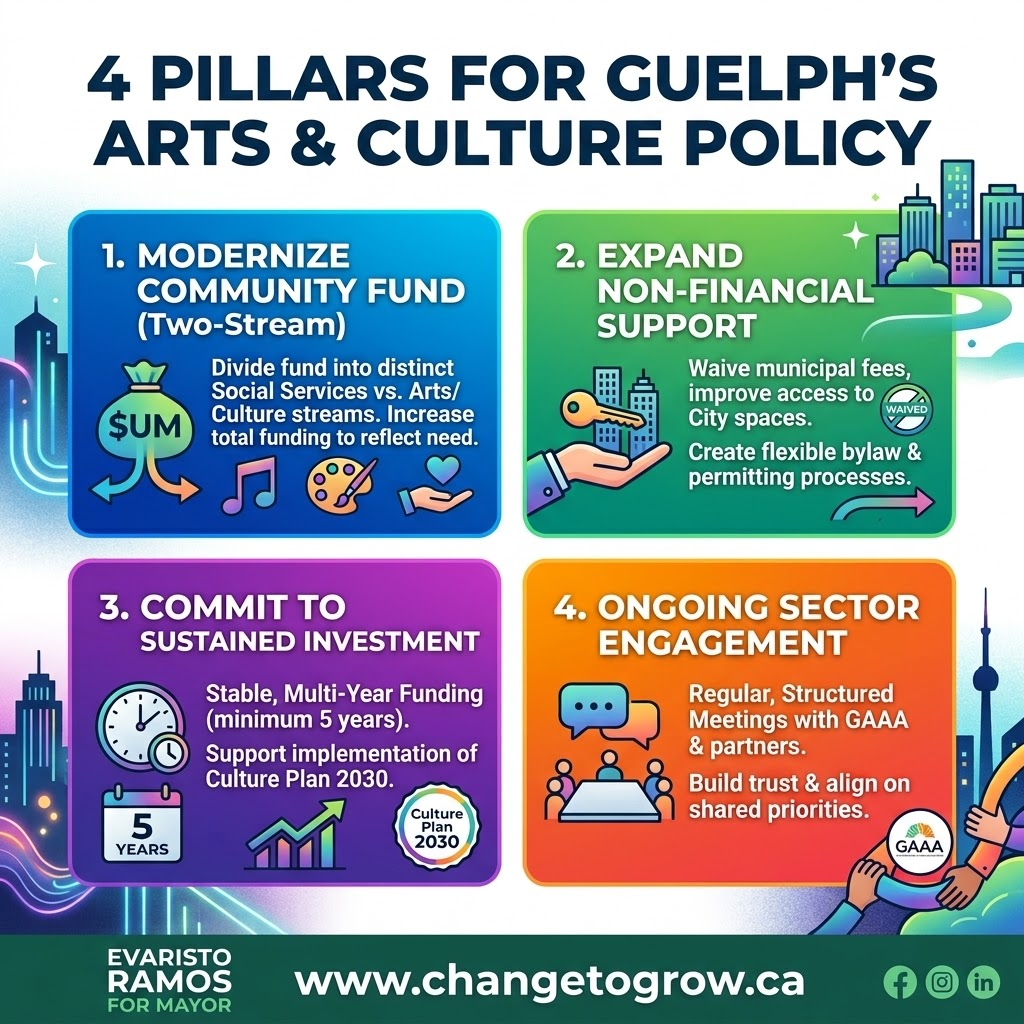
1. Modernizing Grants: A Dedicated Two-Stream Model
Under Guelph’s current grant model, non-profit arts and culture organizations are forced to compete directly against food banks and emergency housing providers within the exact same funding pool. This creates an unproductive zero-sum dynamic. Emergency social services and creative arts groups fulfill fundamentally different roles and require distinct evaluation criteria.
- The Legal Foundation: Under Section 107 of the Ontario Municipal Act, 2001, City Council holds explicit statutory authority to issue municipal grants for any purpose considered to be in the interest of the municipality.
- Proven Ontario Precedents: Cities like Toronto (which separates the Toronto Arts Council grants from social services funding), Ottawa (maintaining a distinct Arts and Heritage Development Program), and Kingston (City of Kingston Arts Fund) have long demonstrated the success of a two-stream model.
- The Commitment: As Mayor, I will advocate during budget reviews to separate municipal grants into two dedicated streams—one for social services and one for arts, culture, and heritage—ensuring fair, specialized evaluation for both.
2. Cutting Red Tape: Expanding Non-Financial Supports
Direct financial grants are only one piece of the puzzle. Overly rigid bylaws, high municipal permit fees, and administrative delays often prevent grassroots cultural events, pop-up performances, and heritage walking tours from ever getting off the ground.
- The Legal Foundation: Under Section 391 (Fees and Charges) and Section 11 (Culture and Parks spheres of jurisdiction) of the Municipal Act, 2001, Council has full authority to establish fee waivers, grants-in-lieu, and flexible public space licensing.
- Proven Ontario Precedents: Hamilton implemented a Creative Spaces Mitigation Strategy to waive standard planning fees for cultural non-profits, while Toronto established streamlined permitting for outdoor arts and historic tours in public parks and plazas.
- The Commitment: We can make an immediate impact without significant new municipal spending by waiving permit fees for local cultural groups, streamlining street-use permits, and making underutilized City-owned spaces easily accessible to local creators and heritage operators.
3. Long-Term Stability: Multi-Year Funding Predictability
Year-to-year grant cycles force non-profit arts groups into continuous administrative uncertainty. This unpredictability makes it nearly impossible to retain talent, plan long-term programming, or leverage matching federal (Canadian Heritage) and provincial (Ontario Arts Council) grants.
- The Legal Foundation: Under Section 291 of the Municipal Act, 2001, Ontario municipalities are empowered to adopt Multi-Year Budgets (MYB) covering up to a five-year cycle.
- Proven Ontario Precedents: London, Ontario utilizes a multi-year budget model that provides 4-year funding predictability to its local arts council, enabling long-term strategic planning and attracting private-sector co-investment.
- The Commitment: I support aligning the implementation targets of Guelph’s Culture Plan 2030 with a multi-year (3-to-5-year) funding framework under Section 291, providing local organizations with the stability needed to build sustainable operations and maximize public investment.
4. Open Dialogue: Structured Sector Roundtables
City Hall works best when it acts as an enabler rather than a roadblock. To keep municipal policies aligned with real-world needs, we must maintain regular, structured communication between elected officials, city staff, and local arts advocates.
- Proven Ontario Precedents: Cities like Mississauga and St. Catharines host structured quarterly roundtables between municipal economic development teams and local creative advocacy bodies to align cultural programming with downtown business growth strategies.
- The Commitment: Openness and collaboration are at the core of my campaign. I commit to establishing regular, structured roundtables with the Guelph Arts Advocacy Alliance, local heritage operators, and independent artists to stay aligned on sector priorities and overcome obstacles together.
Moving Forward Together
Investing in arts, culture, and heritage isn’t just good for our quality of life—it’s smart economic policy for downtown vitality and community growth. By modernizing our grant structures, cutting red tape, providing multi-year stability, and listening to our creative leaders, we can ensure Guelph remains a vibrant hub for culture and innovation.